︎ ADAPT: Vitalink: Level Up your Health.
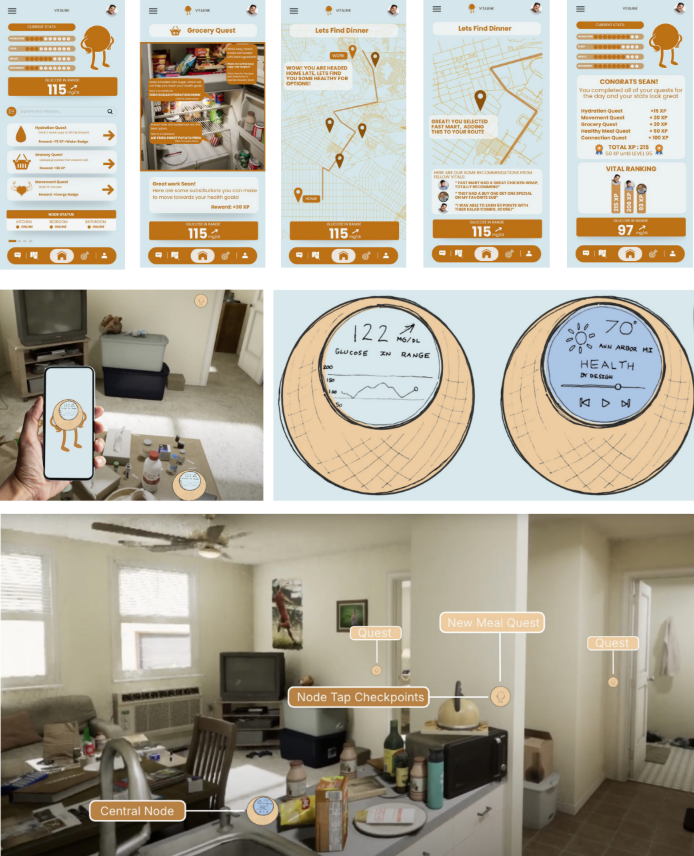
Vitalink is a gamified digital health ecosystem combining a mobile app with small interactive home nodes. The app streamlines diabetes and self-management tasks through reminders, predictions, and real-time data display. Vitalink turns daily health maintenance into rewarding missions with gamification for encouragement, building a supportiveroutine through interaction.
By Ainsley Capps ︎ , Sean Chen ︎, Garrett Dee ︎, & Alex Landgrave ︎

Who
This project focuses on the lives of Sean Gomez and Austin Miller. Sean is a 30-year-old Type-2 diabetic who deals with obesity and is on dialysis. He is a single dad to an 8-year-old daughter who works overnight at a factory, resulting in him having an unhealthy diet and a lack of motivation. Austin is a 19-year-old Type-1 diabetic who has just recently gone off to college and is now learning how to handle his diabetes on his own with less support from his mom. As a college student, he has a very busy and unsteady class schedule, making it more difficult to form a routine. Both users need a health-management system that adapts to their routines and
reduces the mental load of daily diabetes care.
Why
Managing diabetes requires constant attention, whether that's for tracking glucose levels and medication, or nutrition, sleep, and physical activity. For people like Sean and Austin, these responsibilities compete with their busy schedules filled with work, school, and family matters. Many existing tools are informational but not motivational, leaving users overwhelmed. Younger users who haven’t yet built strong routines around their diabetes need a system that supports daily habits in a way that feels doable, while motivating through engaging experiences. Doing this will simplify complex medical routines while fitting naturally within their chaotic
Blood sugar or glucose is the body's source of energy. Insulin is what helps glucose to enter cells, which is where energy is created. Diabetes is a disease that occurs when the body is unable to properly use and store glucose. There are two types of Diabetes. Type one is likely to begin in childhood or as a young adult, but could happen at any age. People with this type will need to watch what they eat to regulate glucose levels. The body stops producing insulin, and daily insulin injections, or use of an insulin pump, are required for survival (Basile, 2020). Those with type 2 are likely to be over the age of 40, overweight, or if diabetes that runs in the family.The pancreas has trouble producing enough insulin necessary to move glucose from the blood into the cells. The greater your BMI, the harder your body must work to produce insulin, so when there is a rise in obesity, there will also be a rise in type 2 diabetes. The spaces used to care for and treat diabetes differ greatly from person to person, but a common factor is how they monitor themselves.
Managing type 1 is a continual process throughout the day, including one or more needle pricks and tracking when and what to eat to maintain good levels. At times, this process can cause stress and worry, which raises blood glucose levels. People might check their glucose levels fewer times a day than others, based on what device they have. In many ways, managing type 2 diabetes through the day is similar to managing type 1, given that patients still produce some insulin; it’s not always necessary to receive additional insulin, but it depends on the circumstances. However, it is still important to check glucose levels regularly and balance what you are eating. With proper management, diet, and physical activity, living with type 2 can be a lot easier than type 1. Neglecting or poorly managing your health can lead to harsher treatments that start to require frequent insulin
injections.
How
Vitalink addresses these challenges by simplifying daily diabetes management through personalized, easy-to-complete habits and motivating, engaging interactions. The system uses adaptive reminders, real-time data, and gamified tasks to make tracking glucose, medication, nutrition, sleep, and activity feel manageable rather than overwhelming. By fitting naturally into busy schedules and guiding users through small, achievable actions, Vitalink helps younger users like Sean and Austin build consistent routines that support their health within the chaos of everyday life.
Nutrition plays a big role in the proper management of diabetes. In both type 1 and type 2 diabetes, it's important to manage what you are eating and develop and maintain a healthy diet. What you eat can have a big impact on your blood pressure. Carbs, in essence, balance the amount of insulin in your body. Whether eating whole carbs vs empty carbs, your body will feel the effects. The American Diabetes Association gives advice on how to eat healthy and properly manage your diabetes. Look at the nutrition facts of what you're buying and eating. Eat regularly with two to three hours between meals to lower glucose. Meal planning can be a useful way to save time and ensure proper meals. When you reach for a snack to determine if you are hungry or thirsty, your mind can trick you when really you might just need water between meals. When snacking, choose a healthy snack that offers protein, healthy fats, and fiber, without carbs. These snacks could include fruit with cheese and nuts, hummus or guacamole with carrots, or peanut butter with apple slices or celery. Eating very poorly with diabetes causes dramatic swings in blood sugar levels, leading to immediate physical and mental symptoms. Over time, unhealthy eating and poor control of blood sugar can lead to long-term complications and even organ
failure.
What
Vitalink is a gamified digital health ecosystem combining a mobile app with small interactive home nodes. The app streamlines diabetes and self-management tasks through reminders, predictions, and real-time data display. Vitalink turns daily health maintenance into rewarding missions with gamification for encouragement, building
a supportive routine through interaction.
Now: Immediately, Vitalink will allow users to start playing and building healthier habits through the app. It will begin connecting users by bringing them together through shared activities and challenges, and introduce early healthy lifestyle rankings to motivate friendly competition and form the foundation of the community.
Near: In the next 3-5 years, Vitalink will introduce home physical nodes that users can install and expand app and game interaction. This will grow the user community and strengthen healthy competition through rewards and ranking systems. Tasks will be extended beyond the home by creating more engaging movement-based gameplay that encourages users to interact with their surrounding environment.
Far: In the next 10 years, Vitalink will grow as a large, engaged community that uses the game for both entertainment and healthy living guidance. Partnering with healthcare providers to deliver credible and professional wellness support within the game will help users consistently practice healthier habits and improve their own overall health.
All the above procedures look easy, but one main challenge for diabetics to put them into practice, especially for new patients, is that they lack the knowledge to do them properly. Many type 2 diabetics lack motivation for a healthy diet and lifestyle practice. Without the right action, it may result in worsening the diabetes and even further health conditions. And we need to think about how to help diabetics learn and establish healthy habits. One strategy that emerged from our research is to use gamification as an attractive hook to start the intervention. Research shows that gamification (the integration of game elements such as points, badges, leaderboards, feedback, and challenges) can improve motivation, engagement, and short-term behavioral outcomes, but its effectiveness is highly dependent on user characteristics and context (Hamari et al., 2014). While many studies report increased participation and enjoyment, they also show limitations such as the novelty effect and the risk that extrinsic rewards may undermine intrinsic motivation if they feel controlling rather than supportive (Dahlstrøm, 2017; Ratinho & Martins, 2023). Poorly designed systems, particularly those relying heavily on competitive leaderboards, can lead to indifference, reduced performance, or counterproductive behaviors (Toda et al., 2018). Benefits such as improved problem-solving, retention, and autonomy are possible when
gamification aligns with user needs and goals, but misalignment can cause distraction, over-competition, or disengagement (Wulan et al., 2024). In the context of a healthy-lifestyle app for diabetics, these findings suggest that gamification may help sustain engagement with diet, activity, and self-monitoring routines, but only if implemented with sensitivity to individual differences, avoiding overly competitive mechanics, and supporting users’ autonomy and competence. Therefore, the design of the gamified system should be intentional, personalized, and non-intrusive to maximize benefits while mitigating potential downsides.
If the app is introduced, one major challenge is how to differentiate it from existing software on the market, attract users, and foster user engagement and loyalty. Based on our research, introducing a ranking system for users and encouraging healthy competition can boost activity and involvement. Research on social comparison
features—including competitive elements like leaderboards—in physical-activity apps shows that social comparison is one of the most commonly used and promising techniques for increasing physical activity and engagement. However, they also warn that poorly designed comparisons can be discouraging for some users. (Arigo et al., 2020) Additionally, a systematic review of mHealth interventions that include social features (c ompetition, cooperation, social support) indicates that apps with social features tend to achieve better engagement and physical activity outcomes than those without, with competitive elements being a recurring mechanism. (Tong et al., 2019) Both studies suggest that a well-designed competition feature can be an effective
way to boost user engagement and help the app or game stand out from the competition. There is also substantial evidence that competitions increase usage and help form habits. A mathematical and computational framework is proposed for the gamification of behavior change, demonstrating how points, rewards, and penalties can be designed to encourage people to consistently choose the “better” behavior until it becomes more automatic. They present gamification as a way to reshape the cost–benefit landscape of daily decisions, supporting habit loops. (Lieder et al., 2024) The literature review “Does Gamification Work?” summarizes empirical results across various domains such as education, health, and crowdsourcing. They find that game elements like points, badges, leaderboards, and streaks can boost motivation, engagement, and persistence—key ingredients for habit formation—especially when aligned with intrinsic goals. (Hamari et al., 2014) Considering all these factors, we believe it can truly support our goal of helping diabetics develop better living habits and manage their condition. Moreover, with a thoughtfully designed system, the potential reach could expand to assist others beyond diabetics in cultivating good lifestyle habits. All the research mentioned above laid the foundation for our intervention proposal. We were able to use it in designing the operation, appearance, and interaction of our app for healthy living.
So What
Vitalink has the potential to transform diabetes management into a supportive, engaging daily practice. Altogether, the app reduces cognitive load, encourages healthier habits in a rewarding way, and improves their quality of life by blending health support with motivation and personalization. Ultimately, it gives users like Sean and Austin a tool that fits seamlessly into their lives, helping them stay healthier, feel more in control, and build long-term habits they can maintain.
Design To Outcomes
Vitalink prioritizes the well-being of its users in its design. Through community integration, quests and rewards, assistance, and reminders we expect to see the following outcomes over time: increased motivation, improved fitness, peace of mind, healthier eating habits, better organization, part of a community.

Links to Follow:
︎︎︎Report
︎︎︎Miro Board
︎
Works Cited
2. Basile, L. M. (2020, July 2). A Day in the Life of Someone With Type 1 Diabetes. Healthcentral.com; HealthCentral. https://www.healthcentral.com/condition/type-1-diabetes/my-type-1-diabetes-routine
3. Dahlstrøm, C. (2017). Impacts of Gamification on Intrinsic Motivation Impacts of gamification on intrinsic motivation. https://www.ntnu.edu/documents/139799/1279149990/04+Article+Final_camildah_f
ors%C3%B8k_2017-12-06-13-53-55_TPD4505.Camilla.Dahlstr%C3%B8m.pdf
4. FDA “Home as a Health Care Hub” Idea Lab | HKS Architects. (2025, September 5). HKS Architects. https://www.hksinc.com/what-we-do/projects/fda-home-as-a-health-care-hub-idea-lab
5, Hamari, J., Koivisto, J., & Sarsa, H. (2014). Does Gamification Work? -A Literature Review of Empirical Studies on Gamification. https://creativegames.org.uk/modules/Gamification/Hamari_etal_Does_gamification_work-2014.pdf
6. Lieder, F., Chen, P.-Z., Prentice, M., Amo, V., & Tošić, M. (2024, March 22). Gamification of behavior change: Mathematical principle and proof-of-concept study. JMIR serious games. https://pmc.ncbi.nlm.nih.gov/articles/PMC10998180
7. Ratinho, E., & Martins, C. (2023). The role of gamified learning strategies in student’s motivation in high school and higher education: A systematic review. Heliyon, 9(8),e19033. https://doi.org/10.1016/j.heliyon.2023.e19033
8. Toda, A. M., Valle, P. H. D., & Isotani, S. (2018). The dark side of gamification: An overview of negative effects of gamification in education. https://www.researchgate.net/profile/Armando-Toda/publication/326876949_The_Dar target="_blank">www.researchgate.net/profile/Armando-Toda/publication/326876949_The_Dark_Side_of_Gamification_An_Overview_of_Negative_Effects_of_Gamification_in_Education/links/5b699b9792851ca650512a90/The-Dark-Side-of-Gamification-An-Overview-of-Negative-Effects-of-Gamification-in-Education.pdf target="_blank">iew-of-Negative-Effects-of-Gamification-in-Education.pdf
9. Tong, H. L., & Laranjo, L. (2018, September 4). The use of social features in mobile health interventions to promote physical activity: A systematic review. NPJ digital medicine.
https://pmc.ncbi.nlm.nih.gov/articles/PMC6550193
10. Wulan, D. R., Nainggolan, D. M., Hidayat, Y., Rohman, T., & Fiyul, A. Y. (2024). Exploring the Benefits and Challenges of Gamification in Enhancing Student Learning Outcomes. Global International Journal of Innovative Research, 2(7), 1657–1674. https://doi.org/10.59613/global.v2i7.238