︎ STRESSFREE: Self-Care: Pathways to Sean’s Healthy Life
This project reorganizes Sean’s home around a calm care corner that supports daily self-care. By aligning spatial interventions with his routines, the design reduces stress, improves consistency in health management, and creates more space for family connection and long-term wellbeing.
By Shweta Chawda ︎ , Ruixue Yang︎, Ranhui Chen ︎, & Dhvanil Pithava ︎

Who
Sean Gomez is a 30-year-old Hispanic single father living in a small 750 sq. ft. one-
bedroom rental apartment in suburban Dearborn, Michigan. He was diagnosed with Type 2 diabetes three years ago and now also lives with obesity and chronic kidney issues that require home dialysis four times a week. He co-parents his 7-year-old daughter, Isabel, who stays with him several days a week. Due to the small space and accumulated clutter, Isabel sleeps in the living room, and Sean struggles with limited storage for medical supplies and healthy food. The tight layout, narrow doorways, and lack of open floor space make it difficult for him to move freely, exercise at home, or establish routines that support his diabetes management. As a result, although he is resilient and dedicated to his daughter, Sean often feels isolated, burned out, and unsupported in building healthier habits
Why
Self-care is essential because it helps maintain physical, mental, and emotional well-
being, allowing individuals to live healthier, more balanced lives. By actively managing health through proper diet, exercise, and regular monitoring, people can prevent chronic illnesses and detect problems early. Mental self-care reduces stress, anxiety, and risk of burnout, supporting emotional stability and resilience. Strong social connections provide support, encouragement, and a sense of belonging, which are crucial for overall well-being. Ultimately, self-care empowers individuals to take control of their health, improve quality of life, and engage more fully with their personal and professional responsibilities.
How
First, we used Lilypad (a VR device) to carefully observe Sean’s home and clearly
identify the existing spatial and lifestyle challenges. Based on this analysis, we defined our research goals, aiming to help Sean focus more on self-care. We conducted detailed research on Sean’s medical conditions, including obesity and diabetes, with particular attention to dialysis patients. Through YouTube videos, we studied their daily routines, spatial needs, and psychological conditions, as well as the physiological and psychological definitions of self-care. We also closely reviewed FDA documentation as a key reference to understand the medical requirements relevant to Sean’s condition. In parallel, we analyzed the specific floor plan of Sean’s home and his everyday living patterns and developed an empathy map to better capture his emotional and behavioral needs. Finally, we used Revit for modeling and rendering to present comparative scenes of the home before and after the intervention.
What
The project centers on understanding what needs to shift in Sean’s home so that
managing his chronic conditions feels less overwhelming and more humane. At its core, the work recognizes that much of Sean’s stress comes not just from his health issues, but from the constant mental effort of navigating a crowded, chaotic environment while trying to care for himself. The central idea is that clearer organization, calmer surroundings, and a more predictable daily flow can help reduce the emotional and cognitive weight he carries. By easing this day-to-day burden, Sean is more likely to feel in control of his routines, make healthier choices, and have more mental and emotional room for his daughter.
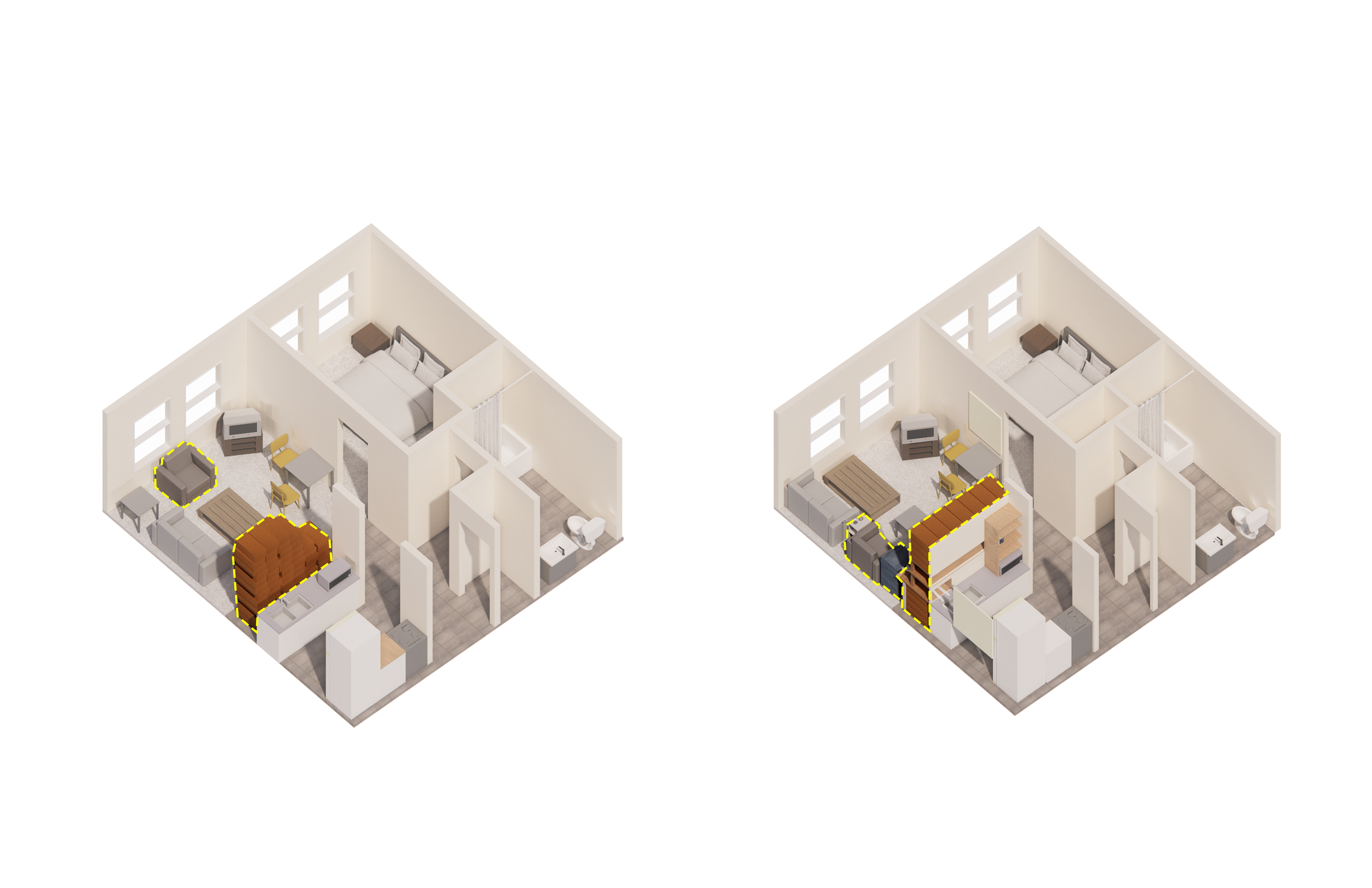
The “Now” part focuses on addressing the current challenges in Sean’s daily life through short-term spatial interventions. We identified three key areas in his home that require immediate improvement. The first intervention targets the area where Sean’s dialysis supply boxes are currently stored. We designed a life rack to consolidate and organize these boxes, incorporating subdivided compartments for daily medical testing tools while allocating dedicated space for dialysis tubes. Openings are introduced to maintain visual connection with the living room, allowing the rack to remain part of the shared domestic space rather than an isolated medical object. Wood is chosen as the primary material because the interior of Sean’s home has a relatively warm color palette, and wood allows the rack to blend seamlessly into the existing living environment. In terms of detail design, we treat the dialysis supply boxes as reusable materials, which can be transformed into drawing surfaces for his daughter. Additionally, smooth openings are integrated into the countertop to allow for easy disposal of waste generated during medical testing. The second intervention focuses on the kitchen area, which is currently cluttered due to a lack of organized storage. We added shelving on the inner side of the kitchen to accommodate everyday kitchen items while reserving space for collecting healthy recipes. Near the refrigerator, we introduced an interactive message board that supports communication between Sean and his daughter. Because Sean works night shifts, their daily interaction time is limited, and this board becomes a space for leaving messages and encouragement, fostering emotional connection within the household.
The third intervention introduces a self-monitoring data board where Sean can manually record his daily health metrics. This board also functions as a shared accountability tool between Sean and his daughter, while providing an indirect educational opportunity for her. The placement of the data board overlaps with Sean’s existing testing locations, ensuring that the design respects and reinforces his established daily routines rather than disrupting them.
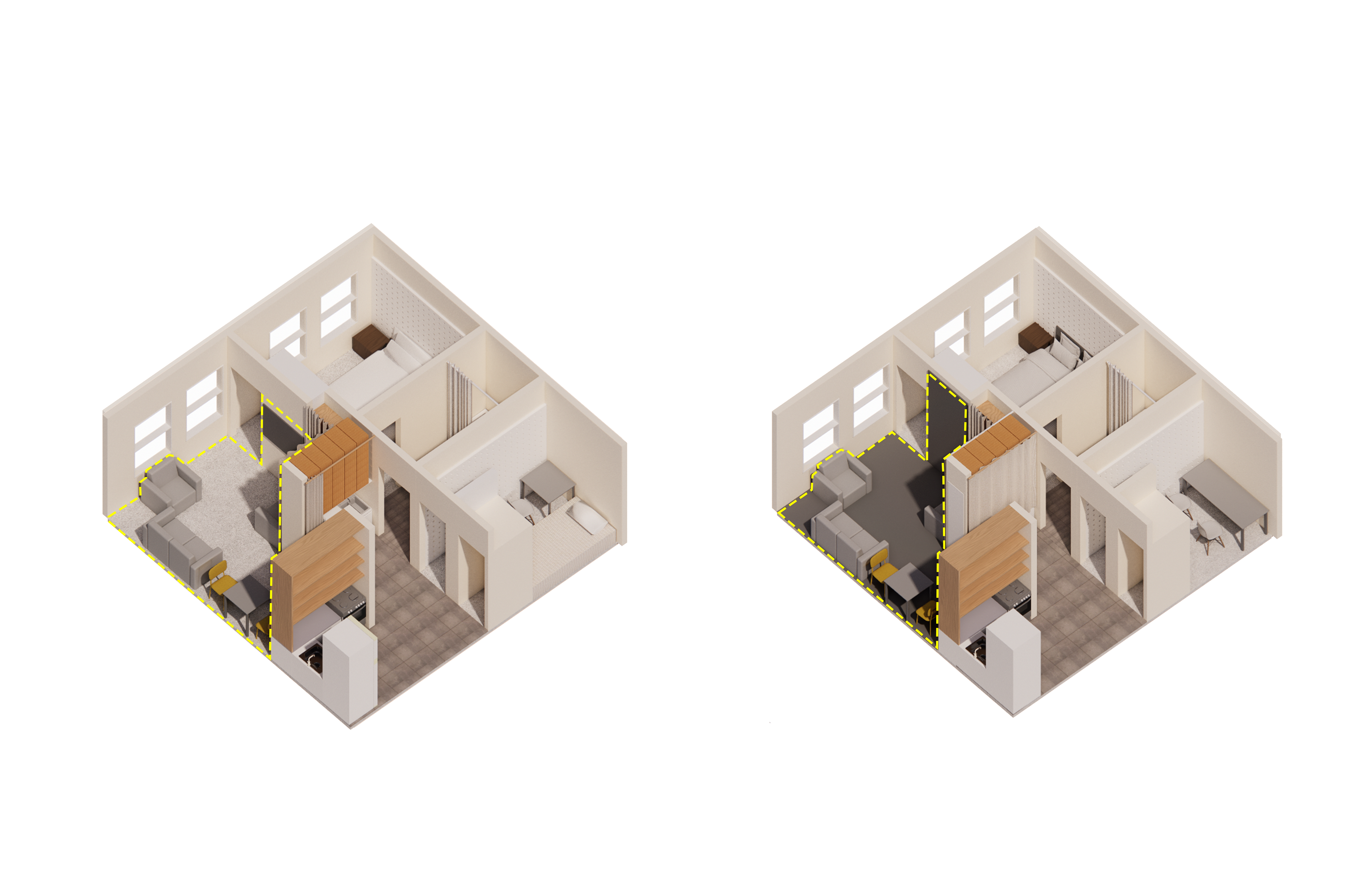
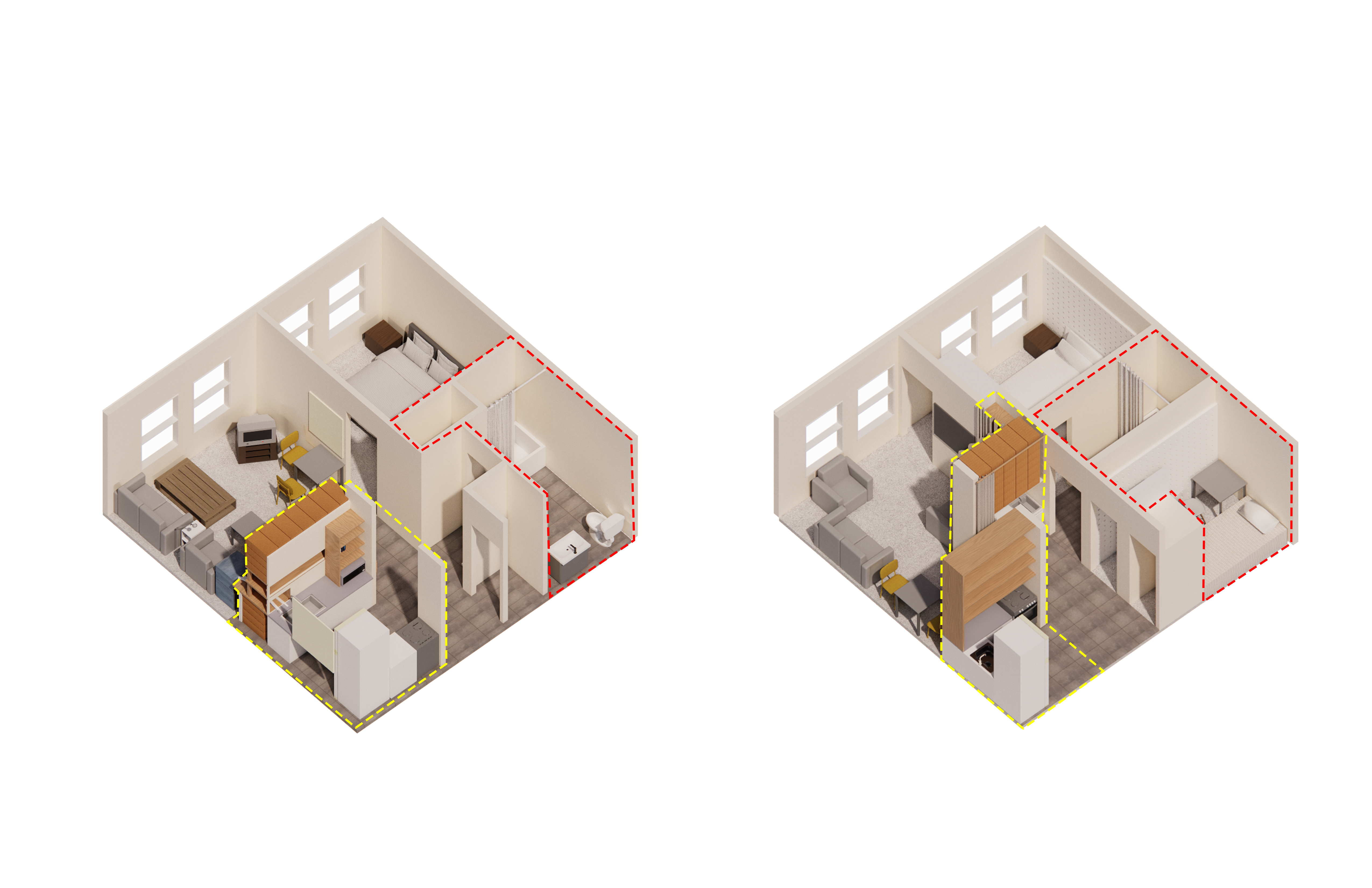
In the near phase, we primarily focus on spatial layout changes within Sean’s home. The first intervention relocates the life rack to the entrance area, making it easier for Sean to unload and organize his supply boxes upon arrival. We also moved the sink from the bathroom to the life rack zone, which supports daily sanitation needs and improves accessibility during dialysis. The dialysis area is positioned directly behind the life rack, allowing Sean to retrieve supplies and begin dialysis with minimal movement. The seating is oriented toward the window, creating a visual and psychological connection to the outside world and offering a moment of engagement
beyond the interior. The second intervention reconfigures the bathroom location and size, reducing excess area and converting the reclaimed space into a dedicated bedroom for his daughter. This adjustment enhances spatial efficiency while better protecting his daughter’s privacy. The third intervention restructures the kitchen layout. While increasing storage capacity, we also expanded the entrance zone as much as possible, allowing Sean more room to organize and manage his supply boxes.
In the far phase, we introduce interactive digital screens to encourage increased physical activity. These screens are designed to monitor Sean’s weight, sedentary time, and overall activity levels, while incorporating motivational feedback mechanisms that prompt and reward movement. In addition, the existing manual data boards throughout the home are transformed into interactive digital interfaces, making daily health data recording more convenient and
consistent.
So What
By creating a calm, organized, and predictable care corner in Sean’s home, daily self-care becomes less overwhelming and less stressful. With reduced clutter and clearer routines, Sean can move through dialysis and diabetes care with greater consistency and less mental fatigue. This shift frees more emotional space for time with his daughter and supports healthier eating decisions, allowing self-care to feel manageable, dignified, and part of everyday life, rather than an exhausting burden.
Design To Outcomes
The project translates Sean’s daily stress points into spatial changes that support his routines and wellbeing by examining key moments in his everyday life. By aligning design interventions with how Sean actually lives, the environment reduces stress, streamlines care routines, and better supports his relationship with his daughter.
Links to Follow:
︎︎︎Report
︎︎︎Miro Board
︎
Works Cited
2. ScienceDirect article Article title unavailable. (2024). ScienceDirect. https://www.sciencedirect.com/science/article/pii/S0950329324000247
3. Everyday Health article Top self-care tips for being stuck at home during the coronavirus pandemic. (n.d.). Everyday Health. https://www.everydayhealth.com/wellness/top-self-care-tips-for-being-stuck-at-home-during-the-coronavirus-pandemic/
4. PMC article 1 Article title unavailable. (n.d.). PubMed Central (PMC). https://pmc.ncbi.nlm.nih.gov/articles/PMC4419447/
5. NIMH webpage National Institute of Mental Health. (n.d.). Caring for your mental health. https://www.nimh.nih.gov/health/topics/caring-for-your-mental-health
6.HelpGuide article Self-care tips to prioritize your mental health. (n.d.). HelpGuide.org. https://www.helpguide.org/mental-health/wellbeing/self-care-tips-to-prioritize-your-mental-health
7. Empathy – Wikipedia Empathy. (n.d.). Wikipedia. https://en.wikipedia.org/wiki/Empathy
8. Psychological projection – Wikipedia Psychological projection. (n.d.). Wikipedia. https://en.wikipedia.org/wiki/Psychological_projection
9. Diabetic nephropathy – Wikipedia Diabetic nephropathy. (n.d.). Wikipedia. https://en.wikipedia.org/wiki/Diabetic_nephropathy
10. Hemodialysis – Wikipedia Hemodialysis. (n.d.). Wikipedia. https://en.wikipedia.org/wiki/Hemodialysis
11. PMC article 2 Article title unavailable. (n.d.). PubMed Central (PMC). https://pmc.ncbi.nlm.nih.gov/articles/PMC10566613/
12. YouTube video How to work night shifts and stay healthy [Video]. (n.d.). YouTube. https://youtube.com/watch?v=RTdBCBvfJa8
13. Evergreen Life article How to work night shifts and stay healthy. (n.d.). Evergreen Life. https://www.evergreen- life.co.uk/health-wellbeing-library/how-to-work-night-shifts-and-stay-healthy/