︎ The Integrated Morning Console
Recontextualizing Points of Decision through Friction-Reducing Groupings and Thresholds
By Caleb Lee ︎

Hypothesis
If insulin, glucose tracking, and eating are spatially grouped into a single threshold environment, then Austin will be more likely to snack before dosing insulin and engage in micro-movement, thereby reducing risk of hypoglycemia and reinforcing health as a natural, repeated sequence rather than a scattered set of tasks.
If insulin, glucose tracking, and eating are spatially grouped into a single threshold environment, then Austin will be more likely to snack before dosing insulin and engage in micro-movement, thereby reducing risk of hypoglycemia and reinforcing health as a natural, repeated sequence rather than a scattered set of tasks.
- Why
Austin’s points of decision are fragmented: insulin pen in drawer, CGM on wrist, food in kitchen. Fragmentation increases error His morning routine is saturated and rushed, scattering decision points across different spaces raising friction. The environment is reconfigured to employ new spatial rituals.
- How
Recontextualize decision points by architecturally grouping them into one designed object. The intervention removes spatial and cognitive barriers. Instead of multiple micro-decisions, Austin encounters a single, frictionreduced sequence at the moment he leaves his bedroom.
- What
Top surface: insulin pen + CGM dock + watch charger (aligned together). Drawer compartment: visible, pre-packaged snacks (banana, granola bar, juice box). Integrated cues: small LED strip activates when drawer opens; citrus scent diffuser cues food presence.
- So What
The intervention makes health architectural by transforming reminders into a material sequence that reduces error and cognitive load while establishing a daily ritual. It reinforces Austin’s autonomy by replacing parental scaffolding with spatial scaffolding, and offers potential as a scalable prototype for modular student-living furniture that supports chronic care.
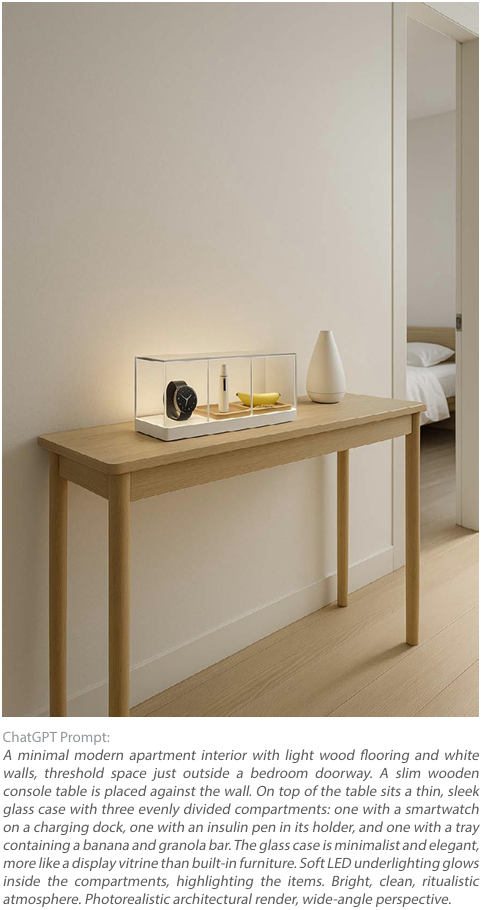
The Link Between Design and Outcomes
By embedding Austin’s devices, insulin, and food into a single architectural threshold, this intervention reframes health management as a spatially bound ritual rather than a dispersed, effortful routine. The Integrated Console reduces friction, aligns decision points, and transforms everyday passage into a moment of embodied care — producing consistent health outcomes while honoring autonomy and routine.
︎︎︎Download The Integrated Morning Console Poster
︎
Works Cited
1. Gustafson CR, Kent R, Prate MR. Retail-based healthy food point-of-decision prompts (PDPs) increase fruit and vegetable purchases. PLoS One. 2018;13(12):e0207792. DOI: https://doi.org/10.1371/ journal.pone.0207792
2. Tuyizere O, Keller C, Bialkova S, et al. Health prompts affect consideration of health and increase choice of healthier food options. Nutrients. 2024;16(10):1454. DOI: https://doi.org/10.3390/ nu16101454
3. Casiraghi C, Pini E, et al. Visual and olfactory nudges in university vending machines increase healthier snack choices. PLoS One. 2025;20(2):e0325804. DOI: https://doi.org/10.1371/journal. pone.0325804
4. Arslain K, Gustafson CR, Roseman MG. Point-of-decision prompts increase dietary fiber content of consumers’ food choices. Appetite. 2021;164:105276. DOI: https://doi.org/10.1016/j. appet.2021.105276 Ajzen I.
5. The theory of planned behavior. Organ Behav Hum Decis Process. 1991;50(2):179–211. DOI: https://doi.org/10.1016/0749-5978(91)90020-T