︎ The Mother’s Respite
Flexible Spatial Design to Support Caregivers
By Arushi Chopra ︎

Hypothesis
Self-care practices enable carers to be present and engaged, benefiting themselves and those they care for. Creating a zone within the home for the primary caregiver of a family to engage in self-care would encourage them to take out time for themselves, knowing that they are still present and their family members are cared for.
Self-care practices enable carers to be present and engaged, benefiting themselves and those they care for. Creating a zone within the home for the primary caregiver of a family to engage in self-care would encourage them to take out time for themselves, knowing that they are still present and their family members are cared for.
- Why
The primary caregiver to a family with diabetes may experience caregiver strain, which could impact children’s diabetes care behavior and health. Knowing the importance of self-care and f inding respite is hugely important.
- How
Flexible spatial zoning according to need allows the carer to engage in selfcare while being present for the family. Updating storage solutions for easy access also simplifies care.
- What
The aim is to allow the mother-as-carer to look after her family while maintaining a routine of self-care. Making snacks accessible fosters independence, creating an uncluttered path makes walking circuits, and setting up a ‘mom zone’ provides a space for personal time.
- So What
Design interventions that transform existing spaces help create psychological boundaries between caregiving duties and self-care activities. This helps reduce cognitive load for the carer and increases the likelihood of engaging in self-care activities, maintaining good health for all.
The Link Between Design and Outcomes
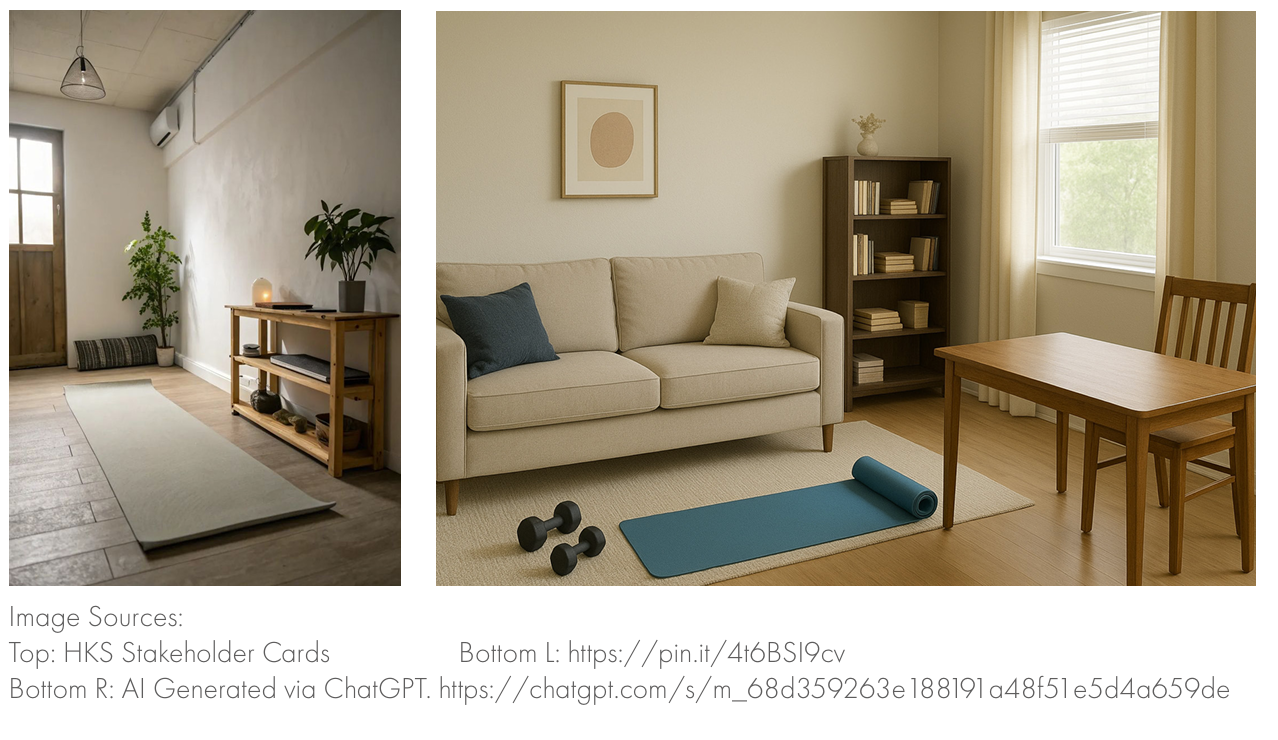
This project is designed for Vivienne Chu, the primary caregiver to her spouse, college-going son, and young daughter- all of who have T1DM. The intent is to enable her to navigate care for herself while caring for her family and monitoring her needs alongside theirs. By utilizing flexible spatial layouts within their existing home, the spaces can accommodate care, family, and personal time. A designated corner in a central part of the house can be the ‘mom zone’, which would be Vivienne’s respite area, encouraging her to take some time to herself while being present and engaged with her family. For example, while her 8 yearold daughter sits at the dining room table to complete homework, she can set up a yoga mat in the living room to stretch, meditate, or workout while keeping an eye on the child. Moreover, updating the existing storage solution to incorporate opaque bins for medical supplies and clear bins for grab-and-go- supplies such as snacks can also foster independence, which further reduces cognitive load for Vivienne and frees up time for her to partake in self-care, enabling her to better take care of her family.
︎︎︎Download The Mother’s Respite Poster
︎
Works Cited
1. Carcone, April Idalski, et al. “Linking Caregiver Strain to Diabetes Illness Management and Health Outcomes in a Sample of Adolescents in Chronically Poor Metabolic Control.” Journal of Developmental and Behavioral Pediatrics 33, no. 4 (2012): 343–351. https://doi.org/10.1097/DBP.0b013e31824eaac8.
2. King, A., J. B. Ringel, M. M. Safford, et al. “Association Between Caregiver Strain and Self-Care Among Caregivers With Diabetes.” JAMA Network Open 4, no. 2 (2021): e2036676. https://doi.org/10.1001/jamanetworkopen.2020.36676.
3. “Unsung Heroes: Family Strength in T1D Care.” Diabetes Research Connection. Accessed November 4, 2025. https://diabetesresearchconnection.org/unsung-heroes-family-strength-in-t1d-care/.
4. “The Importance of Self-Care for Caregivers.” Skills for Health. Accessed November 4, 2025. https://www.skillsforhealth.org.uk/article/the-importance-of-self-care-for-caregivers.