︎ SCREEN: LUMA, Care Together
Screen proposes LUMA, a human-centered digital app interface, designed for families managing Type 1 diabetes. LUMA addresses real challenges like caregiver stress, technology fatigue, sleep disruption, and the constant cognitive load of monitoring data. With advanced, calm, and smart data visualization, LUMA transforms existing home screens and refurbished screens into a peaceful, personalized, and flexible interface. LUMA delivers tailored support for every family member. Caregivers gain clear, streamlined data; children engage through playful health-themed interactions; and adults build confidence in managing their own condition.
By Mira Abdalla ︎, Arushi Chopra ︎, Chun Wang ︎, & Chuwen Zhong ︎

Who
Vivienne Chu is a 46-year-old stay-at-home mother caring for her three family members with Type 1 diabetes while living in a small one-bedroom home and navigating financial constraints and limited space regularly. Her eight-year-old daughter is fully dependent on her for care and management. Her husband and 19-year-old son are more independent but still require her support in managing their illness. To support her family, she needs to constantly monitor and interpret data, make decisions, and interact with multiple devices and digital applications among other things. Due to the level of care she has to provide, she faces individual-level challenges such as sleep disruption, reduced mental well-being, and technology fatigue.
Why
In the U.S., approximately 304,000 children and adolescents under age 20 have been diagnosed with Type 1 Diabetes, which is about 30 per 10,000 youth. An average of 33.5% of parents have reported distress at the diagnosis of diabetes in their child, while 19% have reported distress 1-4 years after diagnosis.
How can we use advanced data visualization to reduce the cognitive load and continued stress of patients with diabetes and their care partners from diabetes management in daily life? (w.r.t. alert fatigue, caregiver burnout, diabetes stress)
How can we use advanced data visualization to promote independent diabetes management for patients so that they are able to achieve a happy and healthy lifestyle through preventative measures, without being reliant on their caregiver and the use of drugs?
How
Our design solution comprises two components: the digital and the physical.
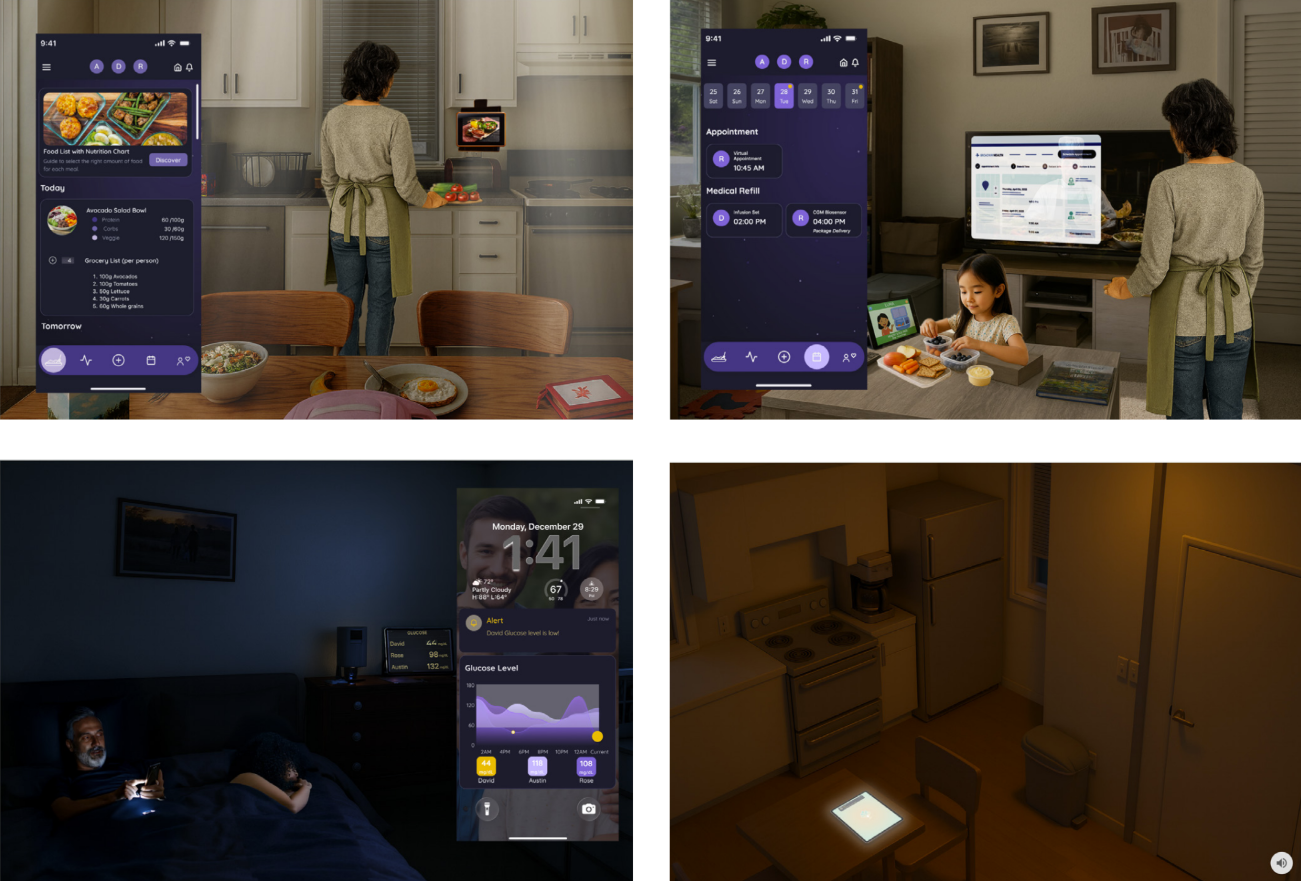
We identified essential categories of information to include on the screens: medical data, nutrition, telehealth support, disease education, and self-care resources. The proposed app, LUMA: Care Together, enables each family member to take ownership of their diabetes management, allowing Vivienne to gradually transition into a more passive caregiver role. This includes the screens’ visual design and placement. Key features include a high-resolution camera, adjustable lighting, gentle sound cues, and considerations for screen size and number. Potential locations include bedside tables, kitchen cabinets, and the living room TV. The system would use both existing household screens and newly acquired refurbished tablets to ensure functionality beyond smartphones. The screens are designed according to the principles of calm technology, supporting healthier circadian rhythms and improved mental well-being.
What
Now:
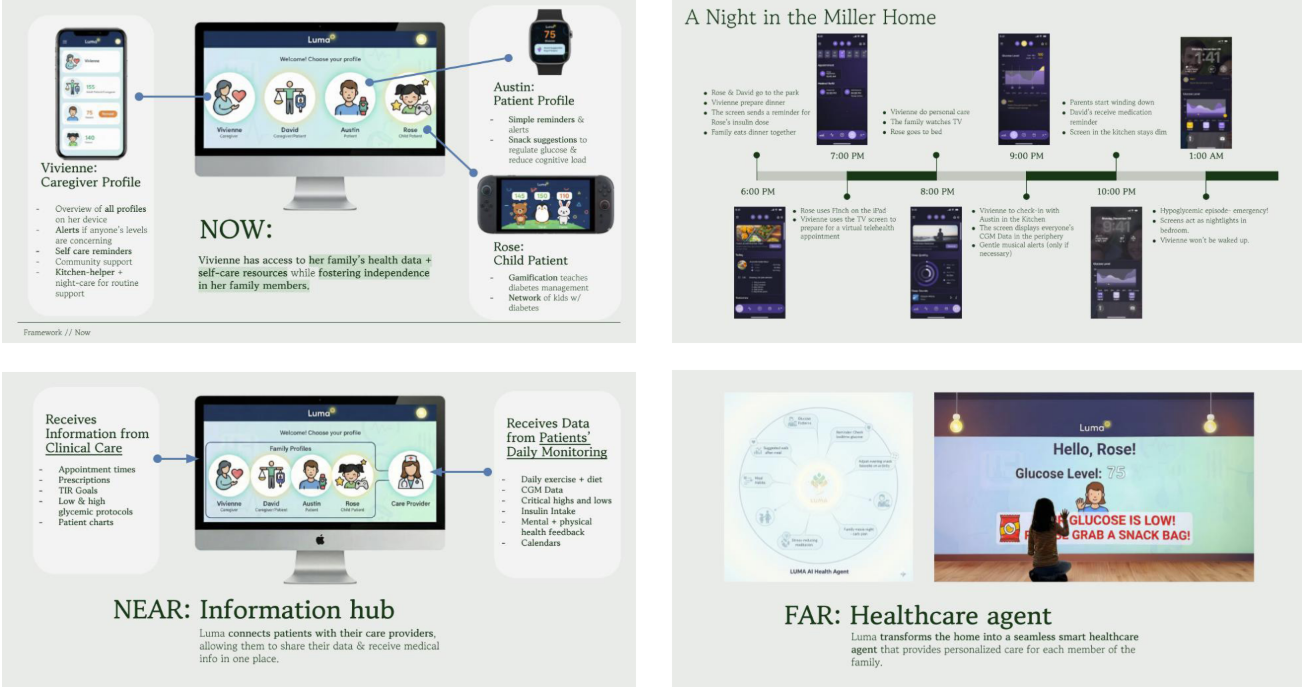
We propose a design solution in the form of a digital app interface called LUMA: Care Together, accessed through existing and new, refurbished screens in the Miller family home. LUMA has profiles for the caregiver Vivienne, patients Austin and David, and child patient Rose. The framework enables Vivienne to access the family's data and self-care resources for herself while enabling her family to gain more independence.
Near:
Luma connects patients with their care providers, giving them resources to manage their diabetes per their endocrinologist’s recommendations, and giving their doctor data to help them provide personalized care and advice. & prescriptions. This connection takes a huge load off of Vivienne, as the app enables family members to connect directly with the doctor & take care of their own health.
Far:
LUMA transforms the home into a care agent. It remains in the background, only activating when necessary. It knows all of the family members’ needs and helps them manage their glucose levels, appointments, & other healthcare needs through data gathered from patients & health providers. It fills most of the role of caregiver, reducing Vivienne’s cognitive load and giving her more time back to care for herself.
Summary:
Over time, LUMA evolves from a supportive app for visualizing and managing diabetes care into a bridge between clinical and home environments, ultimately enabling the home itself to function as a care agent. LUMA reduces the cognitive load Vivienne carries as the primary caregiver by empowering her family members to take greater responsibility for their health and daily diabetes management.
So What
By integrating the app into existing or second-hand screens, the home gains thoughtful, balanced digital support. With intuitive interfaces, glucose tracking, nighttime monitoring, diabetes preparation, and telehealth readiness become less overwhelming. LUMA also supports the development of independence in young patients, easing the emotional and mental strain experienced by caregivers. Through a network of calm, connected screens, LUMA can improve the family’s quality of life, strengthen relationships, and enhance diabetes management. It reduces the time and energy required for caregiving and shifts the role from active to more passive, empowering both patients and caregivers to live fuller, healthier lives.
Design To Outcomes
Vivienne is a stay-at-home mother caring for three family members with Type 1 diabetes, including an eight-year-old daughter who is fully dependent on her. She faces individuallevel challenges such as sleep disruption, reduced mental well-being, and technology fatigue. The familyalso navigates financial constraints and limited space.
Overall, LUMA provides personalized support, screen interventions that tailor data display and interaction to various user needs. Features include health-themed games, kitchen and sleep assistants, reminders, and emergency alerts. With LUMA, adults patients become empowered to manage their own condition and support one another; young patientsfoster independence through playful engagement; and Vivienne can transition into a more supervisory role, reducing constant stress, cognitive load while maintaining safety. Envisioned across a progressive timeline, LUMA evolves with the family’s needs. In the near phase, LUMA integrates provider profile, creating aseamless flow of information between the Miller family and healthcare providers. In the far phase, smart home technology may have much wider capabilities, allowing LUMA to transform the whole home into a smart care agent.
Links to Follow:
︎︎︎Report
︎︎︎Miro Board
︎
Works Cited
2. Azimi, T., Johnson, J., Campbell, S. M., & Montesanti, S. (2024). Caregiver burden among parents of children with type 1 diabetes: A qualitative scoping review. Heliyon, 10(6), e27539. https://doi.org/10.1016/j.heliyon.2024.e27539
3. CDC. (2024, July 23). National Diabetes Statistics Report. Diabetes. https://www.cdc.gov/diabetes/php/data-research/index.html
4. Conroy, D. E., Yang, C.-H., & Maher, J. P. (2014). Behavior change techniques in top-ranked mobile apps for physical activity:
5. Systematic review. Journal of Medical Internet Research, 16(8), e301. https://doi.org/10.2196/jmir.3257
6. Crossen, S. S., & Wagner, D. V. (2023). Narrowing the divide: The role of telehealth in type 1 diabetes care for marginalized communities. Journal of Diabetes Science and Technology, 17(4), 901–908. https://doi.org/10.1177/19322968231157367
7. Dexcom. (n.d.). Dexcom G7 CGM – Powerfully simple diabetes management. Retrieved December 9, 2025, from https://www.dexcom.com/en-us/get-started-cgm/214
8. Dhediya, R., Chadha, M., Bhattacharya, A. D., Godbole, S., & Godbole, S. (2022). Role of telemedicine in diabetes management. Journal of Diabetes Science and Technology, 17(3), 775–781. https://doi.org/10.1177/19322968221081133
9. Diabetes management: How lifestyle, daily routine affect blood sugar — Mayo Clinic. (n.d.). Retrieved December 9, 2025, from https://www.mayoclinic.org/diseases-conditions/diabetes/in-depth/diabetes-management/art-20047963
10. Discover how Signos’ AI app + CGM work for health | Signos. (n.d.). Signos | Glucose Monitoring for Smarter Weight Control. Retrieved December 9, 2025, from https://www.signos.com/how-it-works
11. Home | Calm Tech Institute—Harmonious design principles. (n.d.). Calm Tech Institute. Retrieved December 9, 2025, from https://www.calmtech.institute
12. Kobos, E., Rojkowska, S., Szewczyk, A., & Dziedzic, B. (2023). Burden of care and a sense of loneliness in caregivers of children with type 1 diabetes: A cross-sectional study. BioPsychoSocial Medicine, 17(1), 34. https://doi.org/10.1186/s13030-023-00291-4
13. Kompala, T., & Neinstein, A. B. (2021). Telehealth in type 1 diabetes. Current Opinion in Endocrinology, Diabetes, and Obesity, 28(1), 21–29. https://doi.org/10.1097/MED.0000000000000600
14. Kristaningrum, N. D., Ramadhani, D. A., Hayati, Y. S., & Setyoadi. (2021). Correlation between the burden of family caregivers and health status of people with diabetes mellitus. Journal of Public Health Research, 10(2), 2227. https://doi.org/10.4081/jphr.2021.2227
15. Levels—Live healthier, longer. (n.d.). Retrieved December 9, 2025, from https://framer.levels.com/
16. Lingo by Abbott. (n.d.). Lingo glucose biosensor & app—OTC CGM. Retrieved December 9, 2025, fromhttps://www.hellolingo.com
17. Mair, J. L., Scott, S. E., Butcher, F., & Linde, D. S. (2023). Effective behavior change techniques in digital health interventions for non-communicable diseases: A narrative umbrella review. Chronic Illness, 19(2), 342–361. https://doi.org/10.1177/17423953221116520
18. Michie, S., Richardson, M., Johnston, M., Abraham, C., Francis, J., Hardeman, W., Eccles, M. P., Cane, J., & Wood, C. E. (2013). The behavior change technique taxonomy (v1) of 93 hierarchically clustered techniques: Building an internationalconsensus for the reporting of behavior change interventions. Annals of Behavioral Medicine, 46(1), 81–95. https://doi.org/10.1007/s12160-013-9486-6