︎ The Blue Alternative
Where surplus meets stops
By Fatema Almoamen ︎


Hypothesis
If universities implement excess produce stalls at campus bus stops, then students will be more likely to choose healthy food options over vending machine snacks, leading to reduced food waste and improved access to fresh produce.
If universities implement excess produce stalls at campus bus stops, then students will be more likely to choose healthy food options over vending machine snacks, leading to reduced food waste and improved access to fresh produce.
- Why
According to a study in the U.S. National Library of Medicine, across universities, a student diet consisting of skipped breakfast, frequent snacking, fried food, and a low intake of fruits and vegetables is not sustainable for those dealing with obesity, diabetes, or other health conditions.
- How
The Blue Alternative will approach student dietary health through the reduction of excess produce waste. Instead of 2-3 surplus cupboards around campus, smaller produce stalls will be distributed near populated bus stops.
- What
By distributing surplus stalls, students have the convenience of “grab and go” whole foods rather than relying on processed snacks from the vending machines.
- So What
A study in the U.S. National Library of Medicine revealed that from 2005 to 2030, obesity has been predicted to rise from 33% to 57.8% of the global adult population.
The Link Between Design and Outcomes
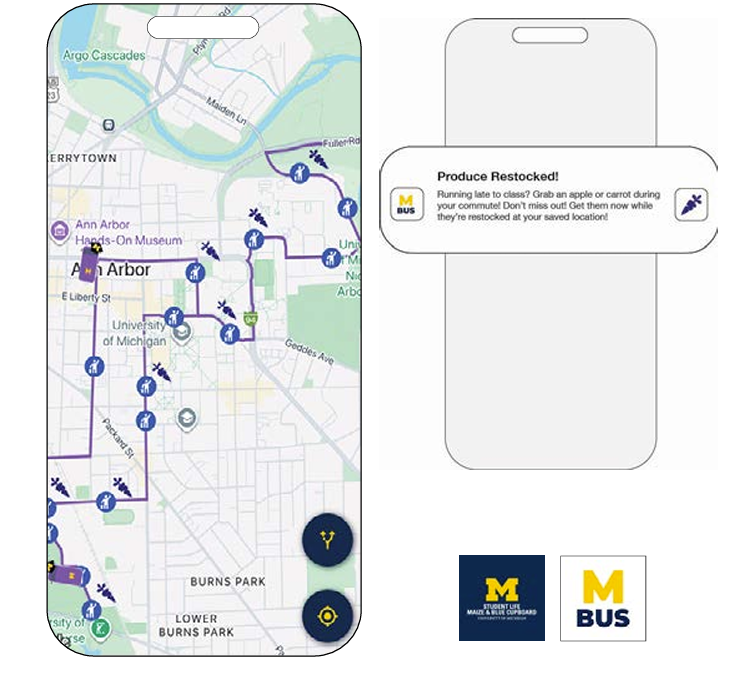
Austin Miller, a diabetic 19 year old student, navigates his health through the convenience of technology. Moving out for college meant no more relying on his parents to provide him with diabetic-friendly meals. Relying on himself has been challenging given that his options on campus have been limited. Yeah, maybe he cooks healthier meals, however, his snacking habits submit to convenience. With his busy class schedule, Austin is hopping back and forth between North Campus and Central campus with little of his time to give to snack stops. Now what if, the snack stops weren’t out of his way but, rather, on his way. The Blue Alternative sources excess produce from the Maize and Blue Cupboard and distributes them through stalls around busy bus stops. How does a student like Austin know whether the stall will be empty or full? The MBus app. Instead of just showing busses, the app will now show where all the stands are situated and even even provide the option of restock push notifications. Therefore, a student can “grab and go” fresh produce such as apples, cucumbers, celery, and carrots right when they get on or off the bus. While also helping to eliminate food waste, students have a healthier range of snacks during their busy school days. As a tech saavy diabetic that seeks efficiency and convenience, Austin could benefit from The Blue Alternative. Being able to check an app and f ind out that fresh celery or cucumber would be available at a bus stop might just be his motivation to leave the bag of pretzels he may have otherwise picked from the vending machine.
︎︎︎Download TheConsciousOffice Poster
︎
Works Cited
1. Yun, Tok Chen, Siti Rohaiza Ahmad, and David Koh Soo Quee. “Dietary Habits and Lifestyle Practices among University Students in Universiti Brunei Darussalam.” The Malaysian Journal of Medical Sciences (May 2018).
2. Maize & Blue Cupboard. Accessed November 4, 2025. https://mbc.studentlife.umich.edu/.